4 Minute Workout for Seniors: The Penn State Routine, Move by Move
The Penn State 4-minute workout is four 30-second moves done daily: push-ups, chair stands, band rows and stepping. In a 12-week trial of 97 adults aged 65 and over with walking difficulty, it added 4.2 chair stands in 30 seconds (PLOS One, 2026). If you can stand from a chair, start with the modified versions.
Key facts
| Fact | Value | Source |
|---|---|---|
| Routine | Push-ups, chair stands, seated two-arm band rows and stair stepping, 30 seconds each, 30 seconds of rest between, every day | PLOS One, Dandekar et al. 2026 |
| Who was in the trial | 97 inactive adults aged 65 and over with walking difficulty, average age 74, 68% women, 12 weeks, randomized to the routine (44) or a waiting-list control (53) | PLOS One, Dandekar et al. 2026 |
| Chair stands in 30 seconds | 4.2 more than the control group (95% CI 2.8 to 5.7) | PLOS One, Dandekar et al. 2026 |
| One-leg stand | 3.6 seconds longer than the control group (95% CI 0.6 to 6.5) | PLOS One, Dandekar et al. 2026 |
| Adherence | 81% of days, about 5.6 days a week | PLOS One, Dandekar et al. 2026 |
| Guideline context | WHO advises older adults to do balance and strength training at moderate or greater intensity on 3 or more days a week | WHO 2020 guidelines, Br J Sports Med |
What is the Penn State 4 minute workout?
The Penn State 4-minute workout is a daily routine of four 30-second exercises, tested in a 12-week trial called FAST-2.
FAST stands for Functional Activity Strength Training. The trial was led by Christopher Sciamanna at Penn State College of Medicine and published in PLOS One in March 2026. The university’s news release followed on June 9, 2026.
Most coverage says “adults 65 and older”. The trial was narrower. Every participant was inactive (under 60 minutes of activity a week, no strength training), 65 or older, and reported difficulty walking a quarter of a mile. That group is the evidence base for this page.
What are the four exercises and how long is each?
The routine is push-ups, chair stands, two-arm seated band rows and stair stepping, each for 30 seconds, with 30 seconds of rest between them.
Participants did them in the same order every day and aimed for as many clean repetitions as they could in each 30 seconds. With rests, a session takes about four minutes.
| Order | Move | Time | How the trial did it | Easier options the trial allowed |
|---|---|---|---|---|
| 1 | Push-up | 30 s | Hands on the floor, toes down | Knees down, hands on a kitchen counter (about 30 in / 76 cm), hands on a stair, or hands on a wall |
| 2 | Chair stand | 30 s | Arms crossed over the chest, standard chair with arms and no wheels, seat about 17 in (43 cm) | Two hands on knees, one hand on a knee, or arms not crossed |
| 3 | Two-arm seated band row | 30 s | Band looped under the arches of both feet, elbows pulled back to the body, shoulder blades squeezed together, feet flat | A lighter band |
| 4 | Stair stepping | 30 s | Step up with one foot, then the other, then back down, on a 4 in (10 cm) step | A lower step, or a chair or wall to touch for balance |
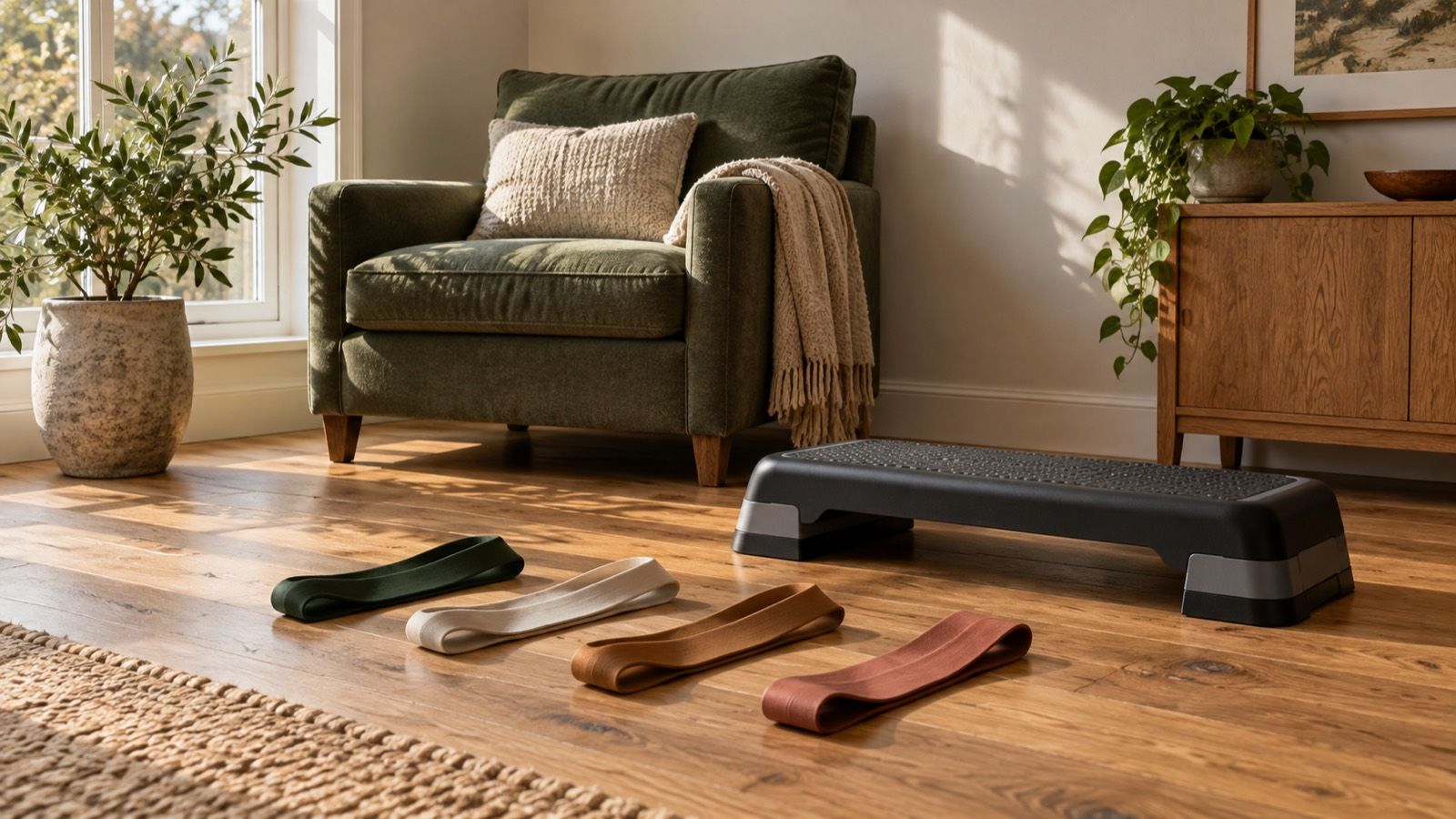
The trial gave each person four bands rated from 10 to 40 lb of resistance and a stepper that adjusts to 4, 6 or 8 inches. Participants were told to put the chair on carpet or against a wall, and to put the stepper in a corner so they could touch a wall if they felt unsteady.
Only the chair stands and the stepping train the legs, so 60 seconds of the four minutes is lower-body work. Add leg exercises for seniors if you want more. The authors stress this point in their abstract.
How did participants progress over 12 weeks?
Participants moved to harder versions when the easier one got easy. The trial gave specific triggers for two of the four moves.
- Push-ups: at 15 repetitions on a modified version, move to a harder one, such as hands on the third stair instead of the fourth.
- Stepping: stay on the 4-inch step until you can stand fully on it six times in 30 seconds, then move to 6 inches, later 8 inches.
- Chair stands: work toward arms crossed over the chest “as they were able to do so safely”.
- Rows: the paper reports that participants used lighter bands when needed. It gives no numeric rule for moving up.
Coaches checked form by video call at baseline and at weeks 2, 4 and 8. The 30-second counts were logged each day, and the team emailed a progress summary every two weeks. That feedback was part of the intervention, so a copy without it is not the same test.
What did the trial find?
After 12 weeks the routine group stood from a chair 4.2 more times in 30 seconds than the control group, held a one-leg stand 3.6 seconds longer and finished five chair stands 2.3 seconds faster.
| Measure | Routine group at start | Change in routine group | Change in control group | Difference between groups (95% CI) |
|---|---|---|---|---|
| 30-second chair stands | 9.5 | +5.08 | +0.87 | +4.2 (2.8 to 5.7) |
| One-leg stand, seconds | 7.3 | +2.72 | -0.85 | +3.6 (0.6 to 6.5) |
| Five times sit-to-stand, seconds | 12.2 | -2.76 | -0.48 | -2.3 (-4.1 to -0.5) |
The group difference is the number to trust, because the control group was a waiting list that did nothing new. For chair stands, the arithmetic is 5.08 minus 0.87, which is 4.21, reported as 4.2. A routine-group member starting at the group average of 9.5 would be around 14.6 stands by week 12.
Other numbers from the paper:
- Adherence: 81% of days, about 5.6 days a week. Dropout was 5 of 44 (11%) in the routine group and 15 of 53 (28%) in the control group.
- Repetitions in daily sessions: push-ups rose from 8.1 to 17.5, chair stands from 7.6 to 16.7, rows from 10.6 to 27.5 and steps from 8.7 to 15.8 per 30 seconds.
- Effort: participants rated chair stands 3.2 on a 0 to 10 scale at the start and 4.6 at the end, which the authors class as moderate.
- Modified versions: used in 40.6% of sessions. Push-ups were modified most often (70.3% of those sessions), usually against a wall.
Is the 4 minute workout safe to do every day?
Seven orthopedic problems were reported in six participants across 2,994 sessions, about one per 427 sessions, with no significant adverse events reported.
Shoulder discomfort was the most common, in 2 of the 6 people. Six of the seven problems led to at least one missed workout. Three of the six people saw a healthcare professional, and one woman with shoulder pain stayed overnight so doctors could rule out a heart attack.
Participants passed a screening questionnaire (the PAR-Q) first. If a move causes sharp pain, stop, and if shoulder pain lingers, see a physiotherapist. Wall push-ups take the load off sore shoulders.
How can you copy it at home without a stepper or four bands?
Counter and wall push-ups and a standard chair were part of the trial. Swapping the supplied stepper and four-band kit for a household stair and one band was not separately evaluated, and it keeps the same four moves.
| Trial equipment | Home option | What to check | Tested? |
|---|---|---|---|
| Push-up on floor | Hands on a kitchen counter or a wall | The counter is about 30 in (76 cm) in most homes per the paper. Wall push-ups were among the most common modifications, and counter push-ups were also allowed. | Yes, in the trial |
| Chair with arms, about 17 in seat | Any sturdy chair without wheels, against a wall or on carpet | Seat height matters, so measure it. A lower or higher seat changes the difficulty. | Chair type yes, other heights no |
| Four bands, 10 to 40 lb | One or two bands with handles or a long loop | Start light. The trial’s participants averaged 10.6 rows in 30 seconds at the start and 27.5 at the end, and could use lighter bands when needed. | One band, no |
| Band under the arches of the feet | Same, feet flat on the floor | The band must not roll off your feet. Reviewers asked about this risk, and the authors added the “feet flat” instruction. | Yes |
| Adjustable stepper (4, 6, 8 in) | A low, solid step or the bottom stair, next to a wall or rail | Measure the height in inches. The trial started at 4 in. Do not use a step that tips or slides. | Stepper only |
| Video coaching and reminders | A phone timer or an interval timer and a daily alarm | The reminders and coaching were part of what was tested. | No |
If you do not own a band, a cheap light one is the closest copy. The timer audio file and daily emails the trial supplied are easy to replace with a phone alarm.
How does the 4 minute workout compare with exercise guidelines?
Done daily, the routine takes about 28 minutes a week including rest, with 14 minutes of active exercise.
The WHO 2020 guidelines advise older adults to strengthen all major muscle groups at moderate or greater intensity on at least 2 days a week, and to do varied balance and strength activity on at least 3 days, alongside 150 to 300 minutes of moderate aerobic activity. At 81% adherence the routine gives about 11 active minutes a week. It covers the frequency target and gives you a daily habit to build on.
The routine covers chest, back and legs in one short block. For a longer program, see strength training for women over 50: your first 4 weeks or what the trials show about building muscle after 60. Both show what a session with sets, reps and rest looks like. The 30-second chair stand test norms tell you what your count means by age, and wall push-ups cover the easiest first move.
What did the Penn State trial not test?
The published paper does not report falls, fractures or muscle size, and the trial did not include people without walking difficulty or run past 12 weeks.
- Hard outcomes. The trial registry lists falls as an outcome, but the paper reports no falls results, so it does not show the routine reduced falls. The researchers say chair stands and one-leg standing predict them.
- Gold-standard tests. COVID rules meant testing was by video, and strength measures such as one-repetition max and the 6-minute walk were not done.
- Long-term results. The trial ran 12 weeks. The authors say people may get bored and adherence may fall. An earlier, smaller trial (FAST-1) saw 73% adherence over 6 months.
- Who was in it. All participants had internet access, which excluded some older adults. The mean age was 74, and 68% were women.
- Size. 97 people is small, and the confidence intervals are wide. The one-leg stand gain could be as small as 0.6 seconds.
- Frequency and dose. No arm tested fewer days a week or a longer session.
- Interests. The trial reports no specific funding. The peer-review file that comes with the paper names the lead author as a part-owner of two companies formed to share findings from exercise studies.
Should you do it instead of a longer workout?
If a longer workout is not happening, a daily four-minute routine is better supported than doing nothing, but the trial did not compare it with longer programs.
Use it as a way in. A simple test is the one the trial used: count chair stands in 30 seconds with arms crossed, note the number, and repeat after a few weeks. The routine group began at 9.5 on average, which gives you a reference point from the trial. For age norms, use the chair stand norms.
If you have been inactive, start with the easier versions in the table above and aim for repetitions you can do with steady form. Build to the harder versions only when the easier ones feel easy.
Frequently asked questions
Is a 4 minute workout enough for seniors?
In one 12-week trial it improved chair stands, one-leg standing and sit-to-stand time in older adults with walking difficulty. It sits alongside the WHO advice for 150 minutes or more of weekly aerobic activity rather than replacing it. The published paper reports function tests, not falls, fractures or muscle size.
What is the Penn State four minute workout?
It is the FAST-2 routine from Penn State College of Medicine: push-ups, chair stands, seated band rows and stair stepping, 30 seconds each with 30 seconds of rest. Participants did it every day for 12 weeks and logged repetitions online.
Do you need the resistance bands and stepper?
The trial supplied four bands (10 to 40 lb) and a stepper adjustable to 4, 6 or 8 inches. A single light band and a low sturdy step are the closest cheap copies, and they get you the same four moves.
How many days a week should older adults do this?
The trial asked for all seven days, and participants managed about 5.6 a week. The trial did not compare 3 days with 7, so the best frequency is unknown.
Is it safe to do every day?
Over 2,994 sessions the trial recorded 7 orthopedic problems in 6 participants, mostly shoulder discomfort, about 1 per 427 sessions. Chest pain or dizziness during a session is a reason to stop and see a doctor.
Sources
- Brief daily functional strength training to improve functional performance in older adults with mobility disability: A randomized trial, PLOS One (Dandekar, Kurth, Shang, Stine, Ladwig, Conroy, Schmitz, Rovniak, Silvis, Danilovich, Ballentine, Pierwola-Gawin, Zhou, Sciamanna), 2026-03-12 (accessed 2026-10-26)
- Four-minute daily workout improves strength, balance in older adults, Penn State University, 2026-06-09 (accessed 2026-10-26)
- Functional Activity Strength Training (NCT05697497), ClinicalTrials.gov (accessed 2026-10-26)
- World Health Organization 2020 guidelines on physical activity and sedentary behaviour, British Journal of Sports Medicine (Bull et al.), 2020-12 (accessed 2026-10-26)
- A Four-Minute Home Workout Improved Mobility In Older Adults With Walking Difficulty, StudyFinds, 2026-06-12 (accessed 2026-10-26)